When offices switched to remote work, business leaders cheered the convenience and the cost savings. But soon enough, a new issue surfaced. How do you maintain productivity, accountability, and engagement when your team is working from home? Even highly dedicated professionals struggle to stay focused while working remotely. Deadlines are missed, teamwork comes to a standstill, and visibility is lost. Outdated management practices, stand-up meetings every day, spreadsheets, or word-of-mouth reporting just aren't sufficient in a remote-first world.
This is where monitoring software becomes the best choice for today's manager. Not a tool of micromanaging, but an operator of trust, openness, and productivity that enables companies to have the data to manage better in a geographically scattered world.
1. Reclaim Visibility and Control Over Remote Operations
The largest bottleneck of remote management is the absence of visibility. Without an image of what the teams are accomplishing, leaders must make decisions in their heads based on assumptions rather than facts. This ambiguity affects not just output, but planning, resource allocation, and client satisfaction. Tracking software eliminates this chaos. It enables managers to:
Monitor task progress and timelines in real time.
Identify workflow bottlenecks before they escalate.
Assess productivity trends across teams and individuals.
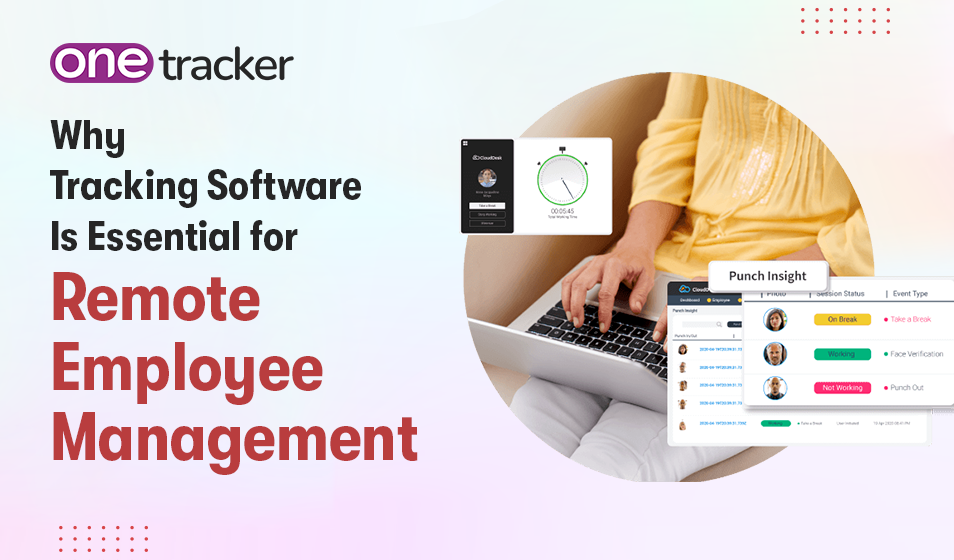
This amount of transparency ensures every hour counts toward business goals, without frequent status meetings or annoying reporting. For instance, tools like OneTracker provide intuitive dashboards that show who's doing what, task duration, and where time can be optimized. The dividend? Enhanced control without micromanaging.
2. Build Accountability Through Data, Not Doubt
Trust is what remote work lives on, but accountability needs to be quantifiable. Employees also want it: clarity about expectations and performance measures. Monitoring software introduces data-driven accountability into remote environments. Instead of subjective impressions of who's "busy," managers can see actual measures of the time spent on projects, working hours, and output levels. This data helps in:
Setting realistic performance benchmarks for teams.
Recognizing top performers with evidence-based metrics.
Identifying support needs for employees who might be struggling.
By aligning productivity measurement with objective data, businesses remove bias and foster a fairer, results-oriented culture.

3. Improve Project Management and Client Billing
For companies that deal with multiple customers or projects simultaneously, such as IT companies, agencies, and consultancies, accurate time tracking is important. Without accurate time tracking, billing becomes chaotic, project estimates are off the mark, and profitability goes down. Software for tracking allows teams to:
Log hours per project or client, ensuring transparent billing.
Analyze workload distribution to optimize staffing.
Forecast timelines based on historical performance data.
Tools such as OneTracker extend beyond simple timesheets with automated reporting, visualized analytics, and task deconstruction that facilitate effortless project tracking. Not only does this keep clients in the loop, but it also increases internal effectiveness and cost management.
4. Empower Employees With Self-Management Tools
Although it's enlightening to the manager, it's also liberating to the employee. When used in an open manner, it liberates professionals to measure their own productivity and set areas of individual improvement. Employees can see how they spend their time, what projects require the most effort, and where they can automate drudgery. It makes tracking more of an aid to personal development than monitoring. Moreover, insights from OneTracker can help team members:
Organize their workdays more effectively.
Balance focus time and collaboration.
Stay aligned with project goals without constant supervision.
When teams take ownership of their own efficiency, productivity rises naturally, without the need for rigid oversight.
5. Strengthen Communication and Performance Reviews
Performance discussions tend to become personal in remote environments. Without insight into daily work habits or effort, criticism can come across as imprecise or unjust. Tracking software closes this knowledge gap by offering measurable performance data that makes criticism more useful. Managers can draw on insights from tools such as OneTracker to talk about:
Workload balance and time allocation.
Achievements and milestones based on tracked metrics.
Areas where process adjustments can improve output.
This data-driven approach leads to clearer, fairer, and more meaningful performance discussions, strengthening trust and alignment between managers and employees.
6. Ensure Compliance and Data Security
For businesses that handle sensitive information, tracking software provides an added layer of confidence. Most contemporary tools feature activity logs, locked-down access controls, and compliance capabilities that guard business information, a requirement when workers use personal devices or mixed networks.
OneTracker's cloud design is secure, so businesses can be sure their remote work follows company and customer data rules, without losing flexibility.
The Bigger Picture
The actual goal of employee monitoring software isn't to spy on workers. It's to facilitate wiser management and better teams. If it's implemented mindfully, it gives leaders visibility, accountability, and efficiency that make remote work viable. It takes the guesswork out, fosters trust with transparency, and permits leaders to lead based on outcomes rather than monitoring.
For business decision-makers, the message is plain: tracking software is not a nicety, it's a necessity for effective management of distributed teams in today's digital-first world.
The Conclusion
In today's hybrid and remote work reality, success hinges on how accurately you track, measure, and manage productivity. With OneTracker, it is simple for large and small businesses to optimize remote worker management with intelligent time tracking, detailed insights, and reporting automation, all in one place. If you're ready to gain clarity, accountability, and control over your remote operations, it's time to discover how OneTracker can transform the way your teams get the job done.
About the Author