In high-stakes auto racing, the difference isn't just the car's power but the precision of its pit stops. For small businesses in 2026, operations are the car, but time is your pit crew. Mastering its efficiency is what separates those who lead from those who are lapped.
With hybrid work becoming more of a reality and augmented by more integrated workflows through AI technology, it has simply become inconvenient to continue to use traditional spreadsheets for your workflow. Below is a compilation of what’s currently working well in small business time management platforms as of today in 2026 and entering 2027.
1. OneTracker
Among today's market noise, OneTracker cuts through with a lean, focused take on productivity. Unlike the platforms that cater by piling on features, OneTracker stays true to what small businesses really want, simplicity paired with precision.
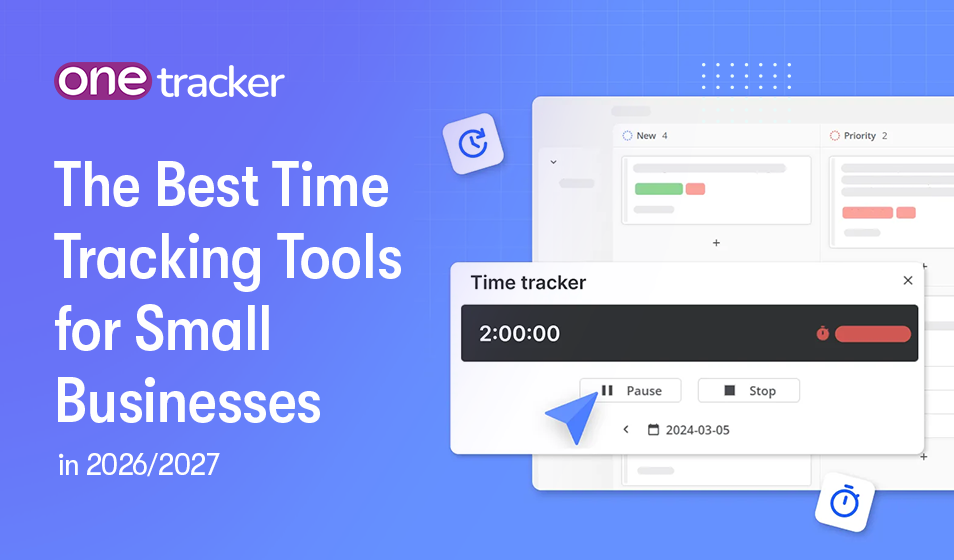
OneTracker is primarily user-centred and is designed to make the daily task of time tracking easier and more convenient. It sports an elegant and modern interface that only requires one click on the clock to log hours, which is critical if the software is to maintain momentum within an organisation. In the business environment of 2026/2027, the software is particularly light on infrastructure because it offers powerful analytics and project time tracking functionality without the usual learning costs associated with older systems that were more project-orientated.

2. Toggl Track
Toggl Track is a constant in the world of time tracking. Known for its versatility, it continues to support a broad range of integration options, including Slack, Trello, and Asana, among others. Having a look at predictions for 2026/2027, the Autotracker feature from Toggl lets you automatically turn on a timer when you launch specific apps. This tool would serve a creative agency or a freelancer handling several accounts for their clients perfectly.
3. Harvest
In terms of billing-centric businesses for smaller operations, Harvest remains an option of choice. They easily incorporate time management within their financial process to ensure supervisors monitor projects’ expenses against budgeted accounts in real time. Enhancements for 2026 improve automated reminders for projects in Harvest to encourage staff to turn in their timesheets on time. While it has a heavier administrative load than other apps, it has a straightforward benefit of linking times worked to bills for professionals.
4. Clockify
Clockify is still a number-one choice for small companies that are budget-conscious, thanks to their tiered pricing plan. It comes with a whole array of features, including time audit functionality, goal setting, and reminders, under one umbrella. For expanding organisations, it is a consistent starting point that provides a good foundation to record presence and GPS tracking functionality for field workers. The reporting console is very detailed and provides a complete overview of where exactly time is being spent by the organisation, capping it at billable and non-billable hours.
5. Hubstaff
Hubstaff is often the go-to for businesses that prioritise detailed workforce management and proof of work. It includes features like activity levels, optional screenshots, and automated payroll integration. As we move onwards to 2027, Hubstaff has refined its "Smart Scheduling" to help managers avoid employee burnout by identifying overextended team members. It is a more robust, "heavy-duty" solution suitable for remote-first companies that require a high degree of transparency in their daily operations.
Choosing the Right Tool for 2026/2027
Selecting time management software has evolved from simply complying with regulations to looking for a partner that can walk with your business as it grows. In considering your options, here are some key points to take note of if you are a small business owner:
User Adoption
What you get out of a tool is what you put in. If a system is complicated, users may opt to ignore it or develop a workaround. This is why simplified systems such as OneTracker are growing in popularity. Since the system is easy to understand, the data entered actually reflects the activity of the day.
Integration Capability
In 2026, no software should exist in a vacuum. Your time tracker should ideally communicate with your project management tool and your accounting software. Whether you are using a specialised tool like OneTracker or a broad platform like Toggl, ensure it fits into your existing "tech stack" without requiring manual data entry between platforms.
Scalability
Small businesses aren’t fixed in one place. The tool you choose now should be able to handle everything from five colleagues to fifty without batting an eye. Look for tools that are able to segment based on projects, so you are able to label time based on client, project, or department as your company gets more complex.
The Conclusion
The 2026/2027 business landscape demands efficiency. Whether one tends toward OneTracker's clean, simplified efficiency. The money-mindedness of or the detailed tracking of the rest, the objective is the same - to track precisely where your most valuable asset is slipping away. With the right tool today, a small business can move from merely investing hours to working smarter.
About the Author